
Table of Contents
- Two Methods, One Goal: Straight, Well-Aligned Teeth
- How Do Braces Work?
- How Does Clear Aligner Treatment Work?
- Which Option Stands Out for Which Cases?
- Aesthetics and Comfort: What Changes in Daily Life?
- How Do Treatment Time and Follow-Up Visits Compare?
- Which Makes Oral Hygiene Easier?
- What Factors Determine the Cost?
- How Is the Decision Made? What to Expect at Your Consultation
- Frequently Asked Questions About Braces and Clear Aligners
Two Methods, One Goal: Straight, Well-Aligned Teeth
One of the questions patients ask most often when they want to correct crowded teeth is this: Should I get braces, or should I use clear aligners? Both are well-established orthodontic tools, and when properly planned, both can move teeth into their intended position. The real difference lies not so much in the end result as in how the treatment feels day to day and which types of cases each one suits.
In this guide, we compare the two methods in terms of how they work, the cases they are suited to, aesthetics, comfort, treatment time, hygiene and cost factors. Our aim is not to hand you a ready-made answer, but to give you a framework for asking the right questions at your consultation. Because there is no single correct answer here — the right choice depends on your individual mouth structure and only becomes clear during a clinical examination.
How Do Braces Work?
In traditional braces treatment, small attachments called brackets are bonded to the front surface of the teeth, and an archwire threaded through these brackets applies continuous, controlled force. Your dentist guides tooth movement by adjusting this wire at follow-up visits. Alongside metal brackets, tooth-colored ceramic brackets may also be used.
Because the brackets are fixed to the teeth, treatment progresses regardless of how disciplined the patient is with daily wear; there is no risk of forgetting to put an aligner back in. This is often considered a reassuring feature in cases requiring complex tooth movements and in younger patients whose wear habits are harder to predict. You can find the stages of braces treatment explained in detail on our orthodontic treatments page.
How Does Clear Aligner Treatment Work?
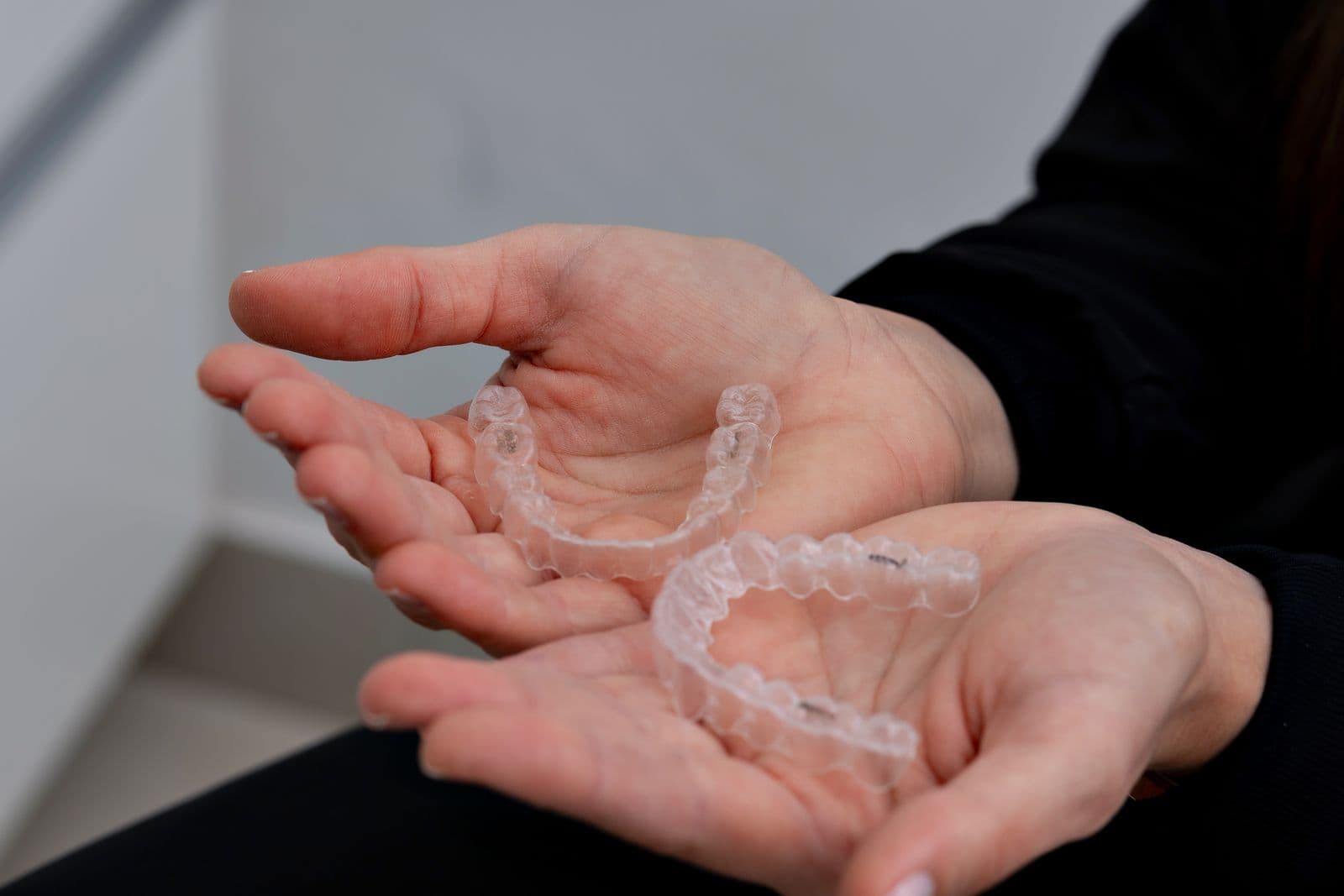
Clear aligner treatment is based on a series of thin, transparent trays custom-made from a digital impression and replaced at set intervals to move the teeth gradually. At the start of treatment, a three-dimensional model of your teeth is created, the movement plan is simulated digitally, and a separate aligner is produced for each step.
The aligners are removable: you take them out to eat and brush your teeth, and wear them for the rest of the day. Thanks to their transparency, they usually go unnoticed while you speak or smile. If you are curious how the process unfolds from start to finish, take a look at our step-by-step guide to the aligner process.
Aligners usually progress in sets worn for one or two weeks each; the slight pressure felt on the teeth when moving to a new set is a normal sign that the planned movement is continuing. The set-change schedule and the total number of aligners are personalized according to the plan your dentist determines.
Which Option Stands Out for Which Cases?
This is the most decisive part of the comparison. For mild to moderate crowding, gaps between teeth, minor rotations and relapse after previous treatment, clear aligners deliver successful results in most cases.
This distinction is not a hard rule; advances in aligner technology continue to expand their range of use every year. Even so, which method suits your case is decided by your dentist after a panoramic X-ray and clinical examination. Additional factors — such as pressure from erupting wisdom teeth — may also change the plan.
In some patients, combined plans that use the two methods one after another may also come into play: for example, once the main correction is completed with braces, the fine-tuning phase can continue with clear aligners. Similarly, partial treatments can be planned for cases where only a limited correction is needed in a single jaw. Such hybrid scenarios show that the two methods should be seen not as rivals but as complementary tools serving the same goal.
Some situations, on the other hand, may call for the controlled force that braces can apply:
- Severe crowding and significant lack of space
- Bite problems with a skeletal origin
- Cases where an impacted tooth needs to be guided into place
- Major root movements and marked corrections of tooth angulation
- Closing wide gaps in treatments involving extractions
Aesthetics and Comfort: What Changes in Daily Life?
The most widely known advantage of clear aligners is their near-invisible appearance. For adults with busy social or professional lives, worry about a metallic look is often what makes them postpone orthodontic treatment; aligners largely remove that barrier. Thanks to their smooth edges, irritation of the cheeks and lips is also rare.
With braces, the brackets may rub against the cheeks during the first weeks, and some sensitivity lasting a few days can follow each wire adjustment; this feeling is usually temporary, and the mouth adapts over time. Hard and sticky foods need to be avoided. Aligner users, by contrast, face no dietary restrictions because the trays come out at mealtimes; however, since the aligners need to stay in for roughly 20-22 hours a day, frequent snackers will need to adjust to that routine.
One small but worthwhile detail in the daily-life comparison is speech: in the first days with clear aligners, a slight lisp may be noticeable on certain sounds; as the tongue adapts to the aligner, this effect usually fades quickly. With braces, those who play contact sports are advised to use a mouthguard, and wind instrument players should allow a few weeks of adaptation. Sharing your lifestyle with your dentist during the examination helps shape the plan accordingly.
How Do Treatment Time and Follow-Up Visits Compare?
With both methods, treatment time depends on the complexity of the case; simple cases may be completed in a few months, while comprehensive corrections can take more than a year. For cases of similar difficulty, the two methods often take a comparable amount of time — what really determines the duration is the case itself rather than the method.
Follow-up schedules do differ, however. Braces require regular adjustment appointments, since every change is made by the dentist. With clear aligners, the trays are planned in advance and can be handed over in sets, so check-up intervals can often be arranged more flexibly depending on the case — a practical advantage for people with demanding schedules and for patients traveling from out of town.
Which Makes Oral Hygiene Easier?
Hygiene rarely gets the attention it deserves when treatments are compared, yet it is the main factor protecting your dental health throughout the process. Brackets and wires create areas on the tooth surface that a toothbrush struggles to reach. Patients wearing braces are advised to adopt a meticulous cleaning routine using interdental brushes and, if needed, a water flosser; otherwise, plaque building up around the brackets may set the stage for enamel stains and early decay.
With clear aligners, the teeth remain uncovered, so brushing and flossing habits continue unchanged; the aligner itself is also cleaned regularly. In this respect, aligners are most effective not for those with weak hygiene habits but, on the contrary, for patients who can wear them with consistent discipline: whenever the aligner is out, tooth movement stops as well.
Neglecting hygiene during treatment can leave its mark with either method; with braces the risk is white spot lesions around the brackets, while with aligners it is prolonged acid contact on the tooth surface if the aligner is put back in without being cleaned. For this reason, professional dental cleanings and check-up examinations at regular intervals serve as the invisible insurance of both treatments.
What Factors Determine the Cost?
The cost of both methods varies with the scope of the case, the anticipated treatment time, the type of materials used (metal or ceramic brackets, the number of aligner sets) and any procedures accompanying the treatment. With clear aligners, the custom digital manufacturing process is the main cost item; with braces, the type of bracket chosen is the deciding factor.
For this reason, reliable cost information can only be given after an examination and X-ray assessment, once your personal treatment plan has taken shape. When deciding, weighing not just the cost but also how well the method fits your case and whether you can sustain the required wear routine tends to serve you better in the long run.
How Is the Decision Made? What to Expect at Your Consultation
Choosing the right method is not a matter of personal preference alone; it is a clinical assessment. During the examination, tooth alignment, the bite relationship, jaw structure and gum health are evaluated; a panoramic X-ray is taken, along with a digital impression if needed. With this information, your dentist explains the likely duration, the limitations and the expected outcome of each method for your specific case.
A thorough assessment covers not only where your teeth are today but also the period after treatment: with both methods, a retention (retainer) phase is planned to help preserve the results. Do not hesitate to raise every scenario on your mind during the consultation — remember, what you are really after is not a particular method but a properly planned treatment.
Today, digital dentistry tools make the decision process easier in many clinics: using a digital impression taken with an intraoral scanner, you can preview on screen how the teeth are planned to move step by step in clear aligner treatment. This simulation is not a guarantee of results; however, it helps you make your expectations concrete and align with your dentist on the same goal.
Frequently Asked Questions About Braces and Clear Aligners
How many hours a day should clear aligners be worn? For the aligners to be effective, wearing them for roughly 20-22 hours a day is recommended. They should stay in at all times except for meals and brushing; as wear time drops, tooth movement slows and treatment may take longer.
Which works faster, braces or clear aligners? In cases of similar difficulty, the durations are often comparable. The main factor determining treatment time is not the method but the degree of crowding, the tooth movements planned and how consistently the patient follows the treatment.
Can clear aligners fix every orthodontic problem? No. They are successful in most mild to moderate cases; however, advanced skeletal problems, impacted teeth and cases requiring major root movements may call for braces or combined approaches. Suitability is determined during clinical examination.
Which option do adults tend to choose? For aesthetic reasons, adult patients often lean toward clear aligners; going unnoticed in social settings and the freedom to eat normally both play a role in that preference. Even so, the final choice should be based on what suits the individual case.
Do teeth shift back after treatment ends? With both methods, teeth may show a tendency to relapse if the retention phase is skipped after treatment. That is why the treatment plan also includes the use of a fixed or removable retainer.
Can people who clench their teeth use clear aligners? Nighttime clenching or grinding may cause aligners to wear out early; in that case, the treatment is planned accordingly. In our article on bruxism, we take a detailed look at how this habit affects dental health. A definitive assessment is made during a clinical examination.
What should I do if my aligner is lost or damaged? Since a lost or cracked aligner can disrupt the treatment schedule, it is advisable to contact your clinic without delay. Depending on the situation, your dentist may plan for you to go back to the previous aligner, move on to the next one, or have a new aligner produced. Storing aligners in their case instead of wrapping them in a napkin during meals eliminates the most common cause of such setbacks.

This content was prepared by the dental team of our clinic in Cukurambar, Ankara. Feel free to contact us with any questions about your oral and dental health.
This content is for informational purposes only; a dental examination is required for diagnosis and treatment.
Have questions? We are happy to help.
Related Articles
Dentures (Removable Prosthesis) Guide: Types, Adjustment Period and Care
Who are dentures suitable for, how are they made, and what does the adjustment period look like? The difference between complete and partial dentures, relining a loose denture, daily care rules and implant-supported options in this comprehensive guide.
Orthodontic Treatment in Children: At What Age Are Braces Fitted?
Have you noticed crowding in your child's teeth? The right time for the first orthodontic check-up, the causes of crowding, the benefits of early treatment, appliance types and braces care — all in this comprehensive family guide.
What Is a Dental Bridge? Types, Procedure Steps and Comparison with Implants
Considering a bridge or an implant for your missing teeth? In this comprehensive guide you will find the types of dental bridges, the step-by-step procedure, the finer points of cleaning under a bridge and a comparison with implants.