
Table of Contents
- What Is a Removable Denture and Who Is It Suitable For?
- What Are the Types of Removable Dentures?
- How Are Dentures Made? Fabrication Steps from Impression to Delivery
- What Does the Adjustment Period Feel Like?
- How Should Removable Dentures Be Cared For?
- Why Do Dentures Become Loose? When Are Relining and Replacement Needed?
- Can Implant-Supported Dentures Be an Alternative?
- Frequently Asked Questions About Dentures
What Is a Removable Denture and Who Is It Suitable For?
A removable prosthesis, commonly known as dentures or false teeth, replaces missing teeth and the surrounding tissues lost with them, and can be inserted and removed by the wearer. Its purpose goes beyond restoring appearance: regaining the chewing function disrupted by tooth loss, making speech clearer and supporting the lips and cheeks that lose their support when teeth are lost are also among the goals of prosthetic treatment.
Removable dentures come into consideration when all teeth in a jaw have been lost, or in partial tooth loss where the number and distribution of the remaining teeth do not allow fixed solutions such as bridges. They are also a frequently chosen option when implant surgery is not considered suitable due to general health or jawbone volume, or when the patient prefers to avoid surgery. Which type of denture is appropriate is determined through a clinical examination, weighing the condition of the remaining teeth, the gums and bone, and the patient's expectations together.
In this guide you will find the types of removable dentures, the fabrication steps from impression to delivery, the adjustment period in the first weeks, daily care rules, the reasons dentures loosen over time, and implant-supported alternatives.
What Are the Types of Removable Dentures?
Removable dentures are divided into different types according to the extent of tooth loss in the mouth and the way the denture is retained. The main types are:
In partial tooth loss, a removable denture is not the only option; fixed bridges supported by neighbouring teeth or implant-supported crowns can also be considered. If you are curious how fixed options work, our dental bridge guide explains the fabrication steps and comparisons in detail. Which approach is suitable becomes clear after the current situation in the mouth is evaluated with an examination and X-rays.
- Complete (full) denture: Used when no natural teeth remain in the jaw. It consists of artificial teeth arranged on an acrylic base that also covers the palate in the upper jaw; it gains its retention from adaptation to the tissues and the suction effect created by saliva.
- Partial denture: Used when some natural teeth remain in the mouth; retention is provided by metal retainers called clasps that grip the remaining teeth, or by a cast framework.
- Precision-attachment denture: A type of partial denture for patients who do not want visible clasps; it is retained by connectors hidden inside crowns made on the remaining teeth.
- Immediate (temporary) denture: A transitional denture inserted in the same appointment as the tooth extractions so the patient is never without teeth during healing; it needs relining or replacement as the tissues remodel.
- Implant-retained overdenture: A removable denture that attaches with special connectors to a small number of implants placed in the jaw; it can noticeably increase retention compared with a conventional complete denture.
How Are Dentures Made? Fabrication Steps from Impression to Delivery
The process begins with a detailed examination: the condition of the remaining teeth, the gums, the shape of the bone ridges and the bite relationship are evaluated, and a panoramic X-ray is taken if needed. If unhealthy teeth need to be extracted, the extractions are done first and the tissues are allowed to heal; an immediate denture can be planned so the patient is not left without teeth during this waiting period.
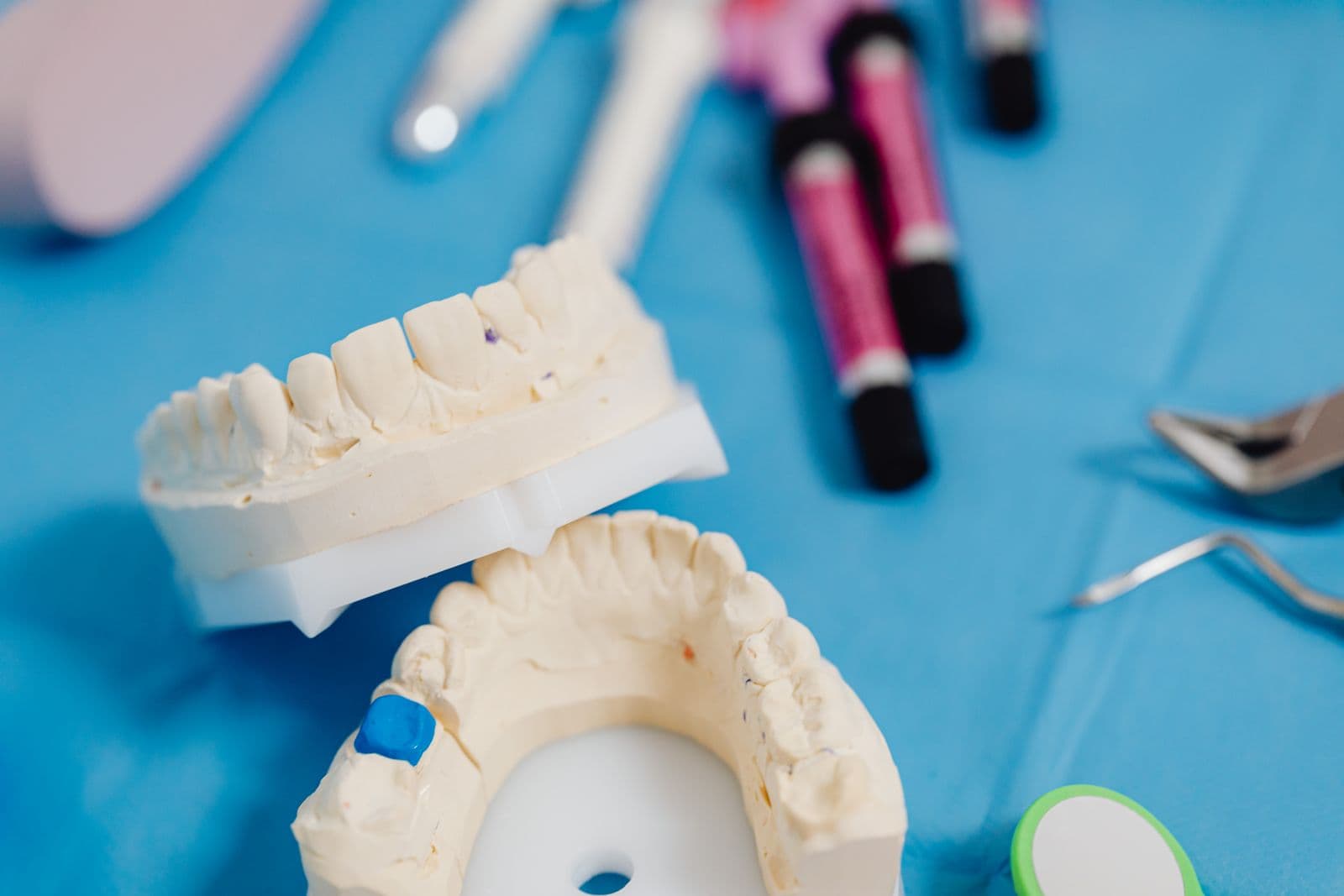
In the fabrication phase, impressions of the jaws are taken first; taking a second, more precise impression with custom trays made from these models is a commonly used method. A bite registration is then made to record the position of the jaws relative to each other, and the length, colour and shape of the teeth are chosen together with the patient. At the try-in appointment, the teeth are tested in the mouth while still on a wax base; changes to the appearance and the bite can easily be made at this stage. After approval, the denture is finished in the laboratory and delivered. The whole process is usually spread over several appointments.
Delivery does not mean the treatment is over. In the first days there may be spots where the denture presses and causes sore points; these areas are relieved by the dentist at follow-up appointments by careful grinding. These small adjustments are a natural part of the process for the denture to adapt fully to the tissues.
What Does the Adjustment Period Feel Like?
A new removable denture is initially a foreign object for the mouth; in the first days a feeling of fullness, increased saliva, mild gagging and difficulty speaking may occur. In most wearers these symptoms gradually decrease as the tissues and muscles adapt to the denture. For speech difficulties, reading aloud and repeating words that feel awkward are simple exercises that can speed up adaptation.
Starting with soft foods, taking smaller bites and chewing on both sides of the mouth at the same time help keep the denture balanced. Since biting with the front teeth can cause a complete denture in particular to tip up at the back, slicing foods such as apples is usually more comfortable. Very hard and sticky foods can be challenging during the adjustment period.
Adapting to a lower denture is harder than the upper one for most wearers: in the lower jaw the area the denture rests on is narrower and the tongue touches the denture with every movement. Over time the tongue and cheeks learn to hold the denture in place and the movement decreases. If there is persistent pain or a sore at specific points, do not try to grind the denture down yourself; the exact location of the pressure point can only be identified and corrected properly at an examination.
How Should Removable Dentures Be Cared For?
Denture care is a habit with two parts: cleaning the denture itself and cleaning the tissues of the mouth. When either is neglected, the bacterial plaque that builds up on the denture surface can pave the way for bad breath, gum inflammation and fungal irritation of the palate. The following rules are recommended for daily care:
Denture wearers continue to need regular dental check-ups: at these visits the fit of the denture, the bite and the health of the oral tissues are evaluated together. Since saliva plays an important role in denture retention, wearers experiencing dry mouth may notice the denture moving and tissue irritation more often; if you have such a complaint, be sure to mention it at your check-ups.
- After every meal, remove the denture and rinse it under running water; food remnants trapped under the denture are a frequent cause of tissue irritation.
- Brush the denture at least once a day with a soft denture brush and a denture cleaning product; some regular toothpastes contain abrasives that can scratch the acrylic surface.
- Clean the denture over a sink filled with water or a folded towel; a dropped denture can break.
- Do not expose the denture to hot water; the acrylic base can deform with heat and lose its fit.
- Take the denture out at night and let the tissues rest; store it in clean water or the cleaning solution recommended by your dentist so it does not dry out.
- After removing the denture, gently brush your palate, tongue and gums with a soft brush; if you wear a partial denture, pay special attention to cleaning the remaining natural teeth and the surfaces the clasps touch.
- If you notice a crack, fracture or loosened tooth on the denture, do not try to glue it at home; improper repairs can permanently ruin the fit of the denture.
Why Do Dentures Become Loose? When Are Relining and Replacement Needed?
A denture that fitted very well at first becoming loose over the years is usually the result of a change in the foundation underneath, not in the denture itself. After natural teeth are lost, bone resorption in the jaw continues, even if slowly; as the bone ridges become thinner, the surface the denture rests on changes and gaps form between the denture and the tissue. A loose denture moves while chewing, can make speech harder and can cause sores on the tissues.
The frequently used solution in this situation is relining: the inner surface of the denture is renewed with new material to match the current shape of the tissues, and in most cases the same denture can continue to be used. When the fit of the base has changed beyond what relining can restore, when the teeth have worn down or the bite has deteriorated, replacing the denture comes onto the agenda; many sources recommend that removable dentures be evaluated and renewed if necessary around every five to seven years on average, although this period can vary markedly from person to person.
Needing denture adhesive every day and in increasing amounts is most often a sign that the fit has deteriorated. Adhesive can provide short-term support; however, wearing an ill-fitting denture with adhesive for a long time can mask the bone and tissue changes progressing underneath. In such a situation the solution is not more adhesive, but having the fit of the denture evaluated at a dental examination.
Can Implant-Supported Dentures Be an Alternative?
The most frequently voiced problem with conventional complete dentures is limited retention, especially in the lower jaw. Implant-retained overdentures, which sit on a small number of dental implants placed in the jaw via special connectors, can reduce this problem considerably: the denture clicks into place, moves less during chewing, and palate-free designs may become possible in the upper jaw. Leaving the palate uncovered can also make an important comfort difference for wearers with a strong gag reflex or those who complain of reduced taste. Because implants transmit chewing forces to the bone, they can also contribute to slowing down bone resorption in toothless areas.
For patients who want a fixed solution that is never removed and whose bone conditions are suitable, options such as All-on-Four treatment, in which a fixed prosthesis is placed on four implants, can be considered. All implant-supported approaches require a surgical process and sufficient bone volume; general health, medications in use and bone density affect suitability. Which option is right for you is a decision to be made together with your dentist, based on an examination and, if necessary, three-dimensional tomography images.
Frequently Asked Questions About Dentures
How long does it take to get used to dentures? The adjustment period varies from person to person, but most wearers feel noticeable relief within a few weeks; full adaptation can take a few months. With a lower denture this period is usually somewhat longer. If significant pain, sores or movement persist beyond a few weeks, the fit of the denture should be evaluated at a dental examination.
Should dentures be taken out at night? The general recommendation is to remove the denture at night to let the gum and palate tissues rest; when a denture is worn continuously, the risk of tissue irritation and fungal inflammation can increase. The removed denture is stored in clean water or a recommended solution so it does not dry out. If a different wearing routine is needed for an individual case, it is decided together with the dentist.
Is it harmful to use denture adhesive? With a well-fitting denture, using adhesive in the recommended amount for extra confidence is generally not considered problematic. However, needing adhesive every day and in increasing amounts can indicate that the fit has deteriorated; in that case, rather than increasing the adhesive, the need for relining or replacement should be evaluated at a dental examination.
How often should dentures be replaced? There is no fixed interval; many sources recommend a comprehensive evaluation around every five to seven years on average. The rate of bone resorption, wear of the teeth and usage habits can shorten or lengthen this period. Regular check-ups make it possible to resolve fit problems with relining before a full replacement becomes necessary.
Can you eat everything with dentures? Once the adjustment period is over, many foods can be eaten comfortably; however, very hard-shelled foods, sticky sweets and chewing gum can remain challenging for a removable denture. Taking smaller bites, chewing on both sides and avoiding tearing bites with the front teeth increase chewing comfort.
Is a palate-free denture possible? Removable dentures that do not cover the palate in the upper jaw are usually possible with implant support or when enough suitable natural teeth are present. Leaving the palate open can improve comfort in terms of taste and the gag reflex; however, since where the retention will come from requires individual planning, suitability is determined at a dental examination.

This content was prepared by the dental team of our clinic in Cukurambar, Ankara. Feel free to contact us with any questions about your oral and dental health.
This content is for informational purposes only; a dental examination is required for diagnosis and treatment.
Have questions? We are happy to help.
Related Articles
Orthodontic Treatment in Children: At What Age Are Braces Fitted?
Have you noticed crowding in your child's teeth? The right time for the first orthodontic check-up, the causes of crowding, the benefits of early treatment, appliance types and braces care — all in this comprehensive family guide.
What Is a Dental Bridge? Types, Procedure Steps and Comparison with Implants
Considering a bridge or an implant for your missing teeth? In this comprehensive guide you will find the types of dental bridges, the step-by-step procedure, the finer points of cleaning under a bridge and a comparison with implants.
Are Dental X-Rays Harmful? A Guide to Radiation Doses and Safety
Worried about getting a dental X-ray? This guide covers the actual radiation doses of panoramic X-rays and CBCT scans, safety principles during pregnancy and childhood, and the protective measures taken in modern clinics.