
Table of Contents
- What Are Clear Aligners and How Do They Work?
- Who Is a Good Candidate — and Who Is Not?
- Clear Aligners vs Metal Braces: The Key Differences
- The Treatment Process, Step by Step
- How Many Hours a Day Should You Wear Them?
- Care and Cleaning: Protecting Your Aligners
- Common Mistakes to Avoid
- What Determines How Long Treatment Takes?
If you would like straighter teeth but hesitate at the thought of wearing metal braces for months, you are far from alone. Clear aligner treatment — often called invisible braces — has become one of the most talked-about options in adult orthodontics. A series of thin, nearly invisible, removable trays gradually moves your teeth, making orthodontic treatment a realistic option for people who care about their appearance in social and professional life.
In this guide we explain how clear aligners work, who is and is not a good candidate, how they differ from conventional braces, what the treatment process involves step by step, and what to watch out for in daily use. Our aim is education, not promotion: as with any orthodontic treatment, only a clinical examination by a dentist or orthodontist can determine which option is right for you.
What Are Clear Aligners and How Do They Work?
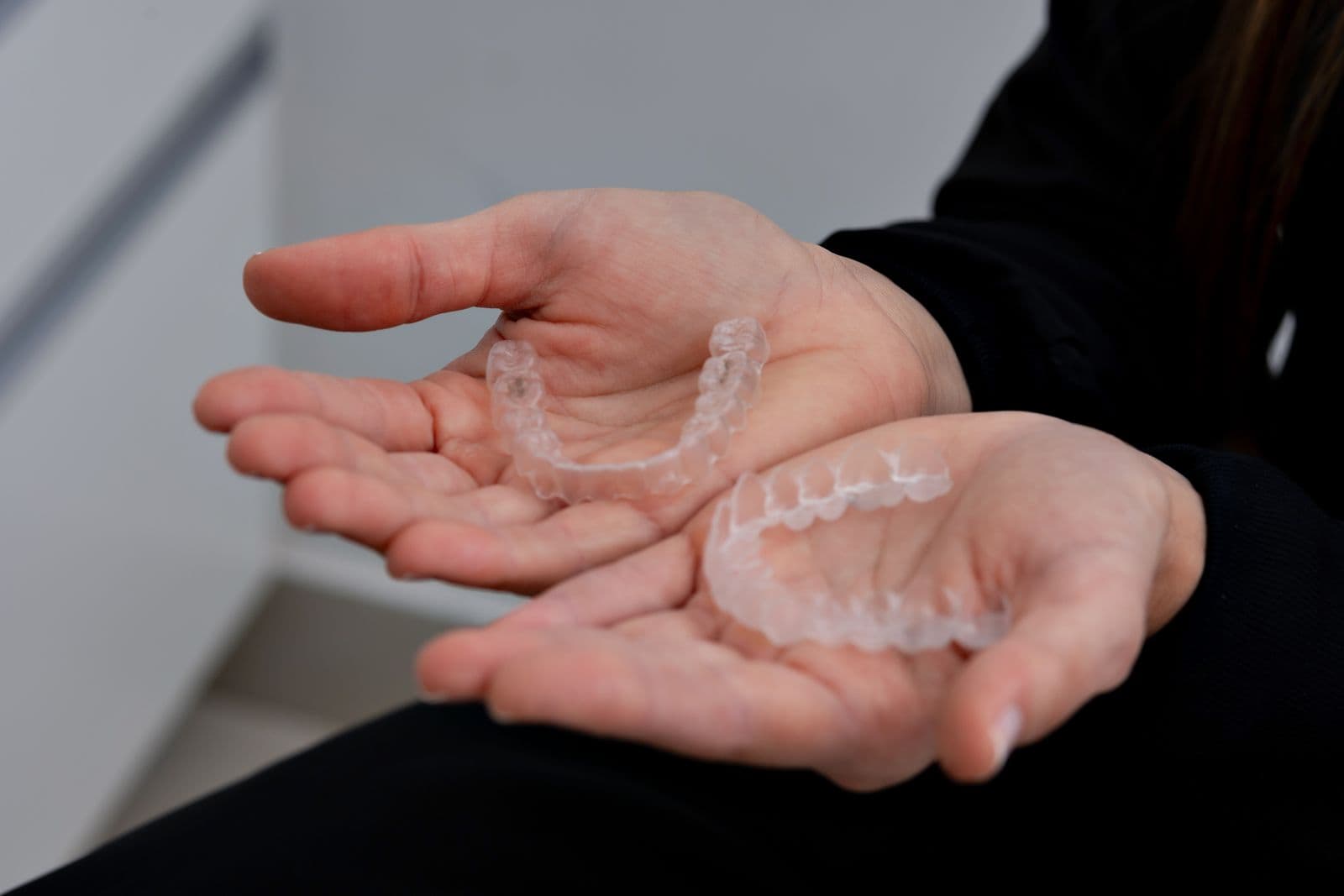
Clear aligners are removable orthodontic appliances made of thin, transparent medical-grade plastic, custom-fitted to your teeth. Each aligner is designed to move your teeth a very small amount — typically around 0.2 to 0.3 millimetres per tray — towards their planned position. The treatment consists of a sequence of aligners, with each new tray carrying the teeth to the next stage of the planned movement.
The biology behind the movement is the same as with fixed braces: light, continuous force applied to a tooth triggers controlled remodelling of the bone around its root. Bone gradually resorbs on the side receiving pressure while new bone forms on the opposite side, allowing the tooth to shift step by step. With aligners, this force is delivered by the tray's precise fit and, where needed, by small tooth-coloured attachments bonded to the teeth to improve grip and control.
Aligners are usually changed for the next tray every 7 to 14 days. The exact interval depends on the amount of planned movement, how your teeth respond, and the protocol your clinician prefers. Success depends heavily on the aligners actually being worn as prescribed — clear aligner therapy is one of the orthodontic methods in which patient cooperation matters most.
Who Is a Good Candidate — and Who Is Not?
Clear aligners are not the ideal solution for every orthodontic problem, and suitability can only be established after a clinical and radiographic examination. As a general framework, mild to moderate alignment issues respond well to aligner therapy in most cases.
Knowing the limits of the method matters just as much as knowing its strengths. Complex cases — significant skeletal discrepancies, severe bite problems, large tooth movements, movements requiring substantial root control, or the guidance of impacted teeth — may not be manageable with aligners alone. In such situations, fixed braces, combined approaches, or surgically assisted options may be discussed.
A removable appliance may also be a poor fit for anyone who doubts they can wear the trays for the recommended hours each day, because tooth movement simply stops whenever the aligner is out of the mouth. Active gum disease or untreated cavities must be addressed before any orthodontic treatment begins. Ultimately, a thorough orthodontic examination is what determines the most appropriate method for you.
Situations in which clear aligners are frequently considered include:
- Mild to moderate crowding (rotated or crowded teeth)
- Gaps between teeth (diastema)
- Minor relapse after previous orthodontic treatment
- Certain types of mild bite discrepancies
- Adults and teenagers who prefer not to wear visible metal braces
Clear Aligners vs Metal Braces: The Key Differences
Both methods rely on the same scientifically established principles of tooth movement; the differences lie in how the force is applied and what daily life feels like. Metal brackets are fixed to the teeth and work continuously under the clinician's control, while aligners are removable and come out for eating, drinking and brushing.
The most relevant everyday differences can be summarised as follows:
- Aesthetics: aligners are rarely noticeable at conversational distance; brackets are visible.
- Hygiene: trays come out, so you brush and floss normally; cleaning around brackets takes more effort and special tools.
- Diet: there are virtually no food restrictions with aligners because you remove them to eat; braces require avoiding hard and sticky foods.
- Comfort: no poking wires or bracket irritation; mild pressure for a few days after switching to a new tray is normal.
- Responsibility: braces work around the clock; with aligners, the result depends directly on wearing them as prescribed.
- Control: for complex tooth and root movements, fixed appliances can offer more predictable results in some cases.
The Treatment Process, Step by Step
Clear aligner treatment is a digitally driven process. The first step is a comprehensive examination: your clinician assesses your teeth, gums and bite, takes the necessary radiographs, and determines whether aligners are a suitable option for you.
Once suitability is confirmed, a three-dimensional digital scan of your teeth is taken. Intraoral scanners usually make conventional impressions unnecessary, producing a precise digital model within minutes. On this model, specialised software is used to simulate the treatment: the sequence, direction and amount of each tooth movement is planned stage by stage. After your clinician reviews and adjusts this virtual plan, your series of aligners is manufactured.
During treatment you change trays according to the agreed schedule. At regular check-up appointments your clinician verifies that tooth movement is progressing as planned; if needed, the plan is updated or additional refinement aligners are produced. Once active treatment is complete, a retention phase begins to keep the teeth in their new positions — typically with retainers worn at night or a thin wire bonded behind the teeth.
How Many Hours a Day Should You Wear Them?
For aligners to be effective, they should stay in the mouth for around 20 to 22 hours a day. In practice, that means removing them only to eat, to drink anything other than water, and to brush your teeth. When the tray is out, no force is applied to the teeth — so insufficient wear directly prolongs treatment or prevents the planned movement from happening at all.
Hot drinks can distort the plastic, so only water is recommended while the trays are in. Coloured drinks such as tea and coffee can also permanently stain the aligners. A practical routine is to take the trays out with meals and put them back in immediately after brushing; this protects both your wear time and your oral hygiene.
Care and Cleaning: Protecting Your Aligners
Keeping your trays clean and clear matters for both comfort and oral health. A neglected aligner can harbour bacteria and cause odour; and because the teeth are partly isolated from saliva's natural cleansing effect while the tray is in, oral hygiene deserves even more attention than usual.
A few points to build into your daily routine:
- Clean the trays daily with a soft toothbrush and lukewarm water; hot water can deform them.
- Avoid abrasive toothpastes — micro-scratches make the plastic look cloudy.
- Always brush your teeth before reinserting the trays; food debris trapped underneath can increase the risk of decay.
- Store the trays in their case, never wrapped in a napkin — that is how most aligners get lost.
- Cleaning tablets can be used if your clinician recommends them.
Common Mistakes to Avoid
The single biggest factor influencing the outcome of aligner treatment is patient habits. Experience shows that certain mistakes come up again and again — knowing them in advance can make your treatment considerably smoother.
The most frequent pitfalls are:
- Wearing the trays less than 20 hours a day and assuming lost time can be made up
- Drinking coffee, tea or sugary drinks with the aligners in
- Switching to the next tray earlier or later than scheduled without your clinician's approval
- Reinserting the tray after meals without brushing first
- Throwing away old trays immediately (the previous tray can serve as a backup if the current one is lost)
- Skipping check-up appointments and reporting problems late
What Determines How Long Treatment Takes?
There is no single answer to the question of how long aligner treatment lasts. Mild crowding may improve within a few months in some cases, while more comprehensive cases can take one and a half to two years. The main factors are the amount and type of tooth movement required, age and bone characteristics, daily wear time, the need for attachments or refinement stages, and each person's individual biological response.
The most important thing to remember is this: digital simulations are a projection, not a promise. Tooth movement is a biological process that varies from person to person, so plan adjustments during treatment are normal and often necessary. If you are considering clear aligners, the first step is an examination by a clinician experienced in orthodontics. Only after that assessment — for example at a clinic with digital scanning facilities such as ADEN Dental in Çukurambar, Ankara — can the most suitable method and a realistic timeline be established for you.

This content was prepared by the dental team of our clinic in Cukurambar, Ankara. Feel free to contact us with any questions about your oral and dental health.
This content is for informational purposes only; a dental examination is required for diagnosis and treatment.
Have questions? We are happy to help.
Related Articles
Orthodontic Treatment in Children: At What Age Are Braces Fitted?
Have you noticed crowding in your child's teeth? The right time for the first orthodontic check-up, the causes of crowding, the benefits of early treatment, appliance types and braces care — all in this comprehensive family guide.
What Is a Dental Bridge? Types, Procedure Steps and Comparison with Implants
Considering a bridge or an implant for your missing teeth? In this comprehensive guide you will find the types of dental bridges, the step-by-step procedure, the finer points of cleaning under a bridge and a comparison with implants.
Are Dental X-Rays Harmful? A Guide to Radiation Doses and Safety
Worried about getting a dental X-ray? This guide covers the actual radiation doses of panoramic X-rays and CBCT scans, safety principles during pregnancy and childhood, and the protective measures taken in modern clinics.