
Table of Contents
- What Is a Dental Cyst?
- Why Do Dental Cysts Form?
- What Are the Symptoms of a Dental Cyst?
- What Are the Types of Dental Cysts?
- What Is the Difference Between a Dental Cyst and a Dental Abscess?
- How Is a Dental Cyst Diagnosed?
- How Is a Dental Cyst Treated?
- What Does Recovery After Dental Cyst Surgery Look Like?
- What Happens If a Dental Cyst Is Left Untreated?
- Frequently Asked Questions About Dental Cysts
What Is a Dental Cyst?
A dental cyst is a pathological cavity that develops at the tip of a tooth root or inside the jawbone, surrounded by a thin membrane and usually filled with fluid or semi-fluid content. The vast majority of cysts are benign and grow very slowly, which means they can exist for a long time without causing any complaints. Many patients first learn about a cyst by chance, on a dental X-ray taken for an entirely different reason.
Slow growth and the frequent absence of pain do not make a dental cyst harmless. As it enlarges, a cyst presses on the surrounding bone and can gradually cause bone resorption, damage to the roots of neighbouring teeth and weakening of the jaw structure. Early diagnosis therefore simplifies treatment and helps limit tissue loss. Regular dental check-ups and X-rays taken at appropriate intervals are among the most effective tools for catching these silent lesions while they are still small.
Dental cysts can occur in any age group; root-tip cysts are most often found in areas where canal infections are concentrated, particularly in the front region of the upper jaw, while in the lower jaw cysts developing around impacted teeth are more prominent. Because the location of the cyst directly influences the neighbouring anatomical structures, the treatment plan and the extent of the operation, the evaluation is tailored to each individual cyst.
Why Do Dental Cysts Form?
The most common cause of a dental cyst is a chronic infection persisting at the root tip of a tooth that has lost its vitality. Deep decay or trauma can cause the dental nerve to die, and over time the body may develop a cystic structure in response to the irritation in this area. The following factors can also contribute to cyst formation:
- Deep, untreated cavities and non-vital teeth
- Blows and injuries to a tooth (the effect may appear even years later)
- Impacted teeth and eruption problems in the jaw
- Previous root canal treatments where the infection at the root tip could not be fully eliminated
- Infected tissue remnants left in the area after a tooth extraction
- Developmental causes arising during tooth formation
What Are the Symptoms of a Dental Cyst?
A dental cyst is an insidious problem: small cysts usually cause no symptoms at all. The severity of symptoms varies according to the location of the cyst, its growth rate and whether it becomes infected. When a cyst grows larger or becomes infected, the following signs may appear:
- Swelling, fullness or a feeling of pressure in the jaw, gums or palate
- Pain or sensitivity when biting and chewing
- Darkening discolouration of a tooth that has lost its nerve
- Loosening, shifting or spacing of teeth
- A bad taste or odour in the mouth, or discharge from the gum margin
- In advanced cases, facial asymmetry and numbness in the lip and chin
What Are the Types of Dental Cysts?
Cysts of the jaw are classified into different groups according to their origin. The grouping below covers the types most frequently seen in practice; rarer types also exist, and the definitive classification is made by tissue analysis. This distinction matters because the treatment plan and follow-up intervals can vary with the type of cyst:
- Radicular (root-tip) cyst: The most common type; it develops in response to chronic infection at the root tip of a non-vital tooth.
- Dentigerous (follicular) cyst: Forms around the crown of an unerupted or impacted tooth; it can be seen in particular around impacted wisdom teeth.
- Residual cyst: Originates from infected tissue left behind after an extraction and appears in an edentulous area.
- Odontogenic keratocyst: A rarer type with a more pronounced tendency to grow and recur compared with the others; it requires regular follow-up after treatment.
What Is the Difference Between a Dental Cyst and a Dental Abscess?
These two conditions are often confused, but their nature is different. A dental abscess is an acute condition in which pus collects in one area due to a bacterial infection; it typically announces itself quickly with throbbing pain, visible swelling and sometimes fever. A dental cyst, by contrast, is a membrane-lined, slow-growing and usually painless chronic lesion.
There is also a close relationship between the two: an untreated infection can pave the way for cyst development over time, and when an existing cyst becomes infected, a painful abscess-like picture can emerge. Which condition is present is determined by the dentist through clinical examination and X-ray evaluation. In both situations, seeking care early makes it easier to relieve the complaints quickly and to treat the underlying cause permanently.
In practice, a rough distinction can serve as a guide: throbbing pain and swelling that increase rapidly within days point more towards an acute infection, whereas a painless firmness that grows slowly over months suggests a cystic lesion. This is only a general tendency, however; a definitive distinction cannot be made without an examination and imaging.
How Is a Dental Cyst Diagnosed?
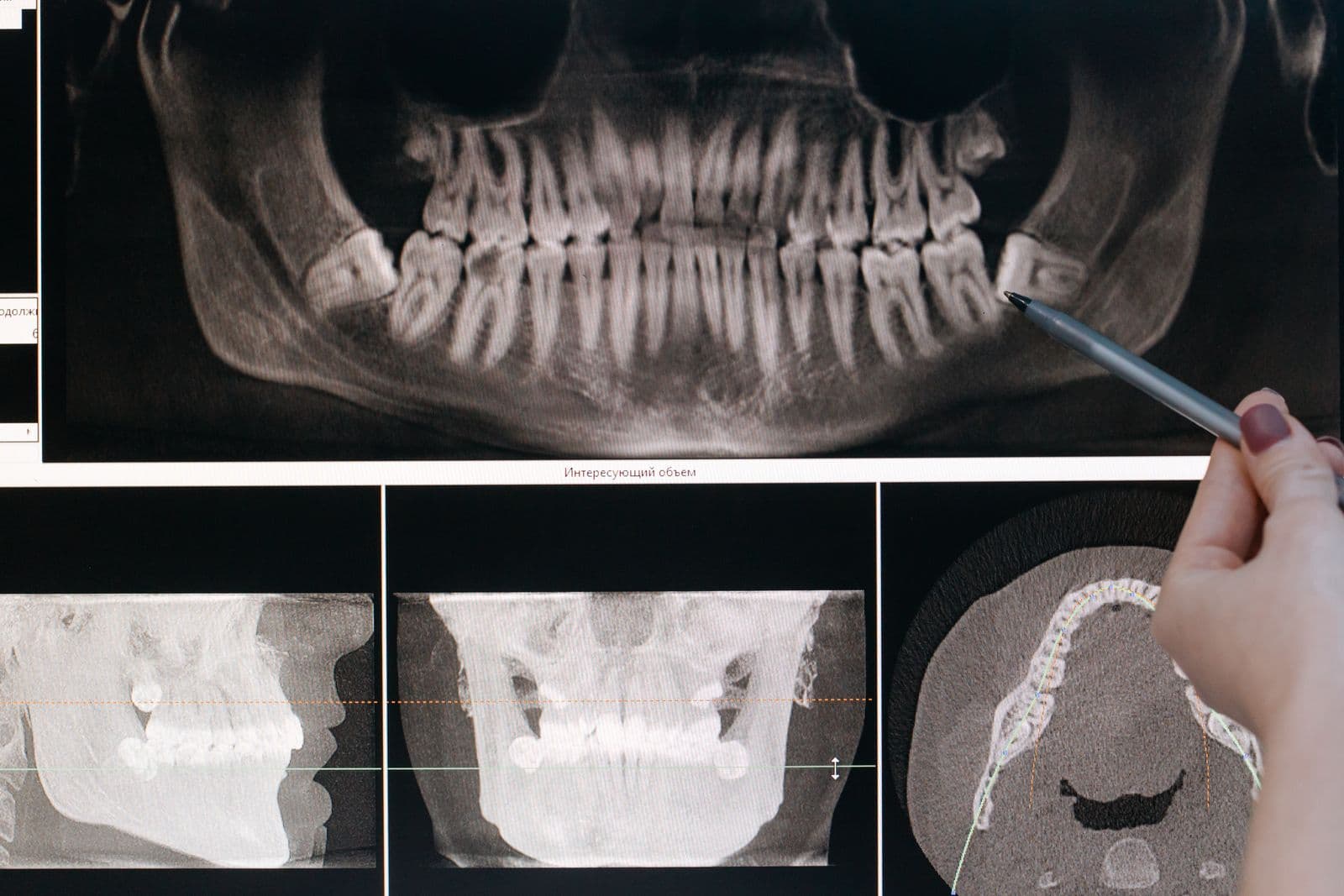
The first step in diagnosis is a clinical examination combined with X-ray imaging. On periapical or panoramic radiographs, cysts appear as dark (radiolucent) areas with usually well-defined borders at the root tip or within the jawbone. The dentist may also assess the vitality of the related teeth with pulp tests.
If the cyst is large or lies close to important anatomical structures such as the nerve canal or the sinus, cone-beam computed tomography (CBCT) may be requested for a three-dimensional evaluation. The exact type of the cyst is established by pathological examination of the removed tissue; this analysis is standard practice for confirming the diagnosis and refining the follow-up plan.
During diagnosis, the cyst needs to be distinguished from an abscess, a granuloma or rarer tumour-like lesions. This distinction is made by evaluating the imaging findings, the vitality of the tooth and, where necessary, a tissue analysis together. No definitive judgement is made from a single X-ray image; requesting further investigation in doubtful cases is a normal part of the process.
How Is a Dental Cyst Treated?
The treatment plan is tailored to the individual by the dentist, based on the size, type and location of the cyst and on whether the associated tooth can be saved. Treatment has two main goals: to remove the cystic tissue completely and to preserve the affected tooth whenever possible. Commonly used approaches include:
- Root canal treatment: In small root-tip lesions, the source of infection is cleaned with root canal treatment; many small lesions may then show a tendency to heal without surgery.
- Apical resection (root-tip surgery): In cases that do not respond to root canal treatment, the root tip is removed surgically together with the cystic tissue, aiming to preserve the tooth instead of extracting it.
- Enucleation: The complete removal of the cyst together with its membrane; in suitable cases it is the most frequently used surgical method.
- Marsupialisation: In very large cysts, the internal pressure is reduced so that the cyst shrinks; the smaller cyst can later be removed with less tissue loss.
- Tooth extraction: Teeth that cannot be saved because of extensive tissue loss may need to be removed together with the cyst.
What Does Recovery After Dental Cyst Surgery Look Like?
Cyst operations are mostly performed under local anaesthesia within the scope of oral and maxillofacial surgery; pain is not expected during the procedure. The surgical site is closed with sutures and the removed tissue is sent for pathological examination. Mild swelling, bruising and discomfort that can be managed with painkillers are normal in the first days. The sutures are usually removed after about a week or dissolve on their own; filling of the bony cavity with new bone can take months and is monitored with follow-up X-rays. To support healing, the following points are recommended:
- Applying intermittent cold compresses from the outside during the first 24 hours
- Preferring soft, lukewarm foods in the first days and avoiding very hot or hard foods
- Continuing to brush the other teeth gently while protecting the surgical area, and using a mouth rinse if recommended by the dentist
- Staying away from smoking and alcohol, as they can delay healing
- Taking the prescribed medication regularly and keeping all follow-up appointments
What Happens If a Dental Cyst Is Left Untreated?
An untreated cyst can continue to grow. Over time, significant bone loss in the jaw, damage to the roots of neighbouring teeth and loosening of teeth can develop; if the cyst becomes infected, painful abscess episodes may occur. Very large cysts can weaken the jawbone and, in rare cases, even increase the risk of fracture. For this reason, it is important to follow the treatment or monitoring plan recommended by the dentist even for cysts that cause no symptoms. How quickly this picture progresses cannot be predicted in advance; two cysts of the same size can follow quite different courses.
In cases where a tooth is lost because of a cyst, fixed solutions such as implant treatment can be planned to replace the missing tooth once the area has healed. Early diagnosis and treatment both increase the chance of saving the existing tooth and help make the subsequent restorative process simpler.
Even in the absence of complaints, it is worth not postponing the evaluation of a cyst discovered incidentally on an X-ray: the smaller the cyst is at the time of treatment, the more limited the procedure usually remains and the more comfortable the recovery tends to be.
Frequently Asked Questions About Dental Cysts
Can a dental cyst go away on its own? Because it is a membrane-lined structure, a dental cyst is generally not expected to disappear by itself. Small root-tip lesions may regress after root canal treatment; however, the dentist decides which cyst can be monitored and which needs treatment, based on the examination and X-ray findings. When a cyst is placed under observation, keeping to the follow-up intervals ensures that any growth is noticed early.
Is a dental cyst dangerous — can it turn into cancer? The great majority of dental cysts are benign, and malignant transformation is very rare. Nevertheless, pathological examination of the removed tissue is standard practice for a definitive diagnosis; this also allows rare conditions to be detected at an early stage.
Is dental cyst surgery painful? Since the procedure is performed under local anaesthesia, pain is not expected during the operation. The mild pain and swelling that may occur over the following few days can usually be managed comfortably with the painkillers recommended by the dentist and cold compresses.
How long does recovery after dental cyst surgery take? Soft-tissue healing is usually largely complete within one to two weeks, while the bony cavity may take months to fill with new bone. The duration depends on the size of the cyst and the person's general health, so the process is monitored with follow-up X-rays.
Can a dental cyst come back after treatment? When the cyst membrane is removed completely, the likelihood of recurrence is generally low. In certain types, such as the odontogenic keratocyst, this tendency is more pronounced, which makes check-ups and X-ray follow-up at the intervals planned by the dentist especially important.
What replaces a tooth extracted because of a cyst? Once bone healing in the area is complete, the missing tooth can be restored with options such as an implant, a bridge or a prosthesis. Which method is suitable is determined through a dental examination that evaluates bone volume and overall oral health. Where considered necessary, additional procedures to increase bone volume can also be included in the planning.

This content was prepared by the dental team of our clinic in Cukurambar, Ankara. Feel free to contact us with any questions about your oral and dental health.
This content is for informational purposes only; a dental examination is required for diagnosis and treatment.
Have questions? We are happy to help.
Related Articles
Dentures (Removable Prosthesis) Guide: Types, Adjustment Period and Care
Who are dentures suitable for, how are they made, and what does the adjustment period look like? The difference between complete and partial dentures, relining a loose denture, daily care rules and implant-supported options in this comprehensive guide.
Orthodontic Treatment in Children: At What Age Are Braces Fitted?
Have you noticed crowding in your child's teeth? The right time for the first orthodontic check-up, the causes of crowding, the benefits of early treatment, appliance types and braces care — all in this comprehensive family guide.
What Is a Dental Bridge? Types, Procedure Steps and Comparison with Implants
Considering a bridge or an implant for your missing teeth? In this comprehensive guide you will find the types of dental bridges, the step-by-step procedure, the finer points of cleaning under a bridge and a comparison with implants.